
B E T H A N Y J O Y L E N Z
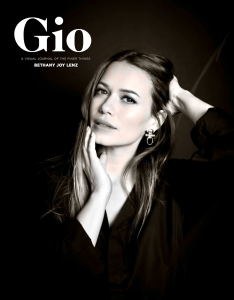
INTERVIEW & PHOTOGRAPHY BY { John Russo
PRODUCED BY { Photohouse Productions
HAIR BY { Jaycee Mnirajd
MAKEUP BY { Saisha Beecham
STYLING { Joann Black
LOCATION { Los Angeles California
JR: I am so excited to talk to you — you are like the Renaissance woman to end all Renaissance women. The author, the actress, the singer. What can’t you do? What are you not doing?
BJL: (laughs) That’s it, really. I just don’t know how to do life any other way. I’ve tried! Even when I was young, I tried to fit into that box — standardized testing, regular school hours — and I just could not stop daydreaming. I’d stare at the cinder block the room was built out of and wonder why they painted all the walls the same color, or imagine what else you could make out of cinder blocks besides schoolhouses. My brain was and is always imagining and creating, which is so fun — but it does have its downfalls. I can be distracted easily if my present moment is lacking stimulation, and it makes math a particular challenge. (laughs) But I’ve learned a lot of patience over the years and gained an appreciation for the magic of ordinary days.
JR: What’s so cool is that your first book, Dinner for Vampires, came out in 2024, became a bestselling memoir — and then you just decide: I’m going to do another book. Tell me about that thought process. How does your mind make that leap?
BJL: Once I’d finished Dinner for Vampires — something clicked. I would often walk through a bookstore and think, I’m going to write a book one day, but it’s such a huge task and I didn’t know where to start, despite having always been a writer of things- I wrote songs and journaled furiously when I was young. I started a book when I was twelve, got about ten chapters in, then abandoned it and moved on to something else — very true to my neurodivergence. (laughs)
Later, it was musicals, librettos, short stories, poetry, scripts. It’s in my bones, but I was focused on acting, then being in a cult really stole the next 10 years of my ambition. When I left One Tree Hill I was exhausted and surviving as a single mom while trying rebuild my life. There were a lot of detours. When I was given a chance to write my story and finally arrived on these literary shores, if you will, I knew there would be no going back.
JR: So, The Betrayal of Cora Wexford is your first work of fiction, releasing October of this year with Simon & Schuster. What inspired the move into historical psychological thriller? Was that always a genre you loved?
BJL: It is a genre I’ve always been drawn to. From Goosebumps to Hitchcock films as a kid, and later to more sophisticated works like A Clockwork Orange, 1984, anything by Agatha Christie and Daphne DuMaurier… I’m an Engram 5 through and through—an Investigator. I’m fascinated by (and I think I have a healthy fear of) our capacity as humans to rationalize anything.
Since I, begrudgingly, have so much experience with narcissists, and I seem to be pretty good at making lemonade, that seemed like the right place to start. Soon, I found myself missing my exits on the highway or losing track of time for daydreaming about the Victorian era. How to take that great Ingrid Bergman film Gaslight a few steps further. I wanted to explain what it feels like to be inside a relationship with a covert narcissist, and what it does to the entire community involved, but write it in a way that I would enjoy. I wasn’t looking for a slog through abuse. Much like Dinner for Vampires—my aim was to wrap a difficult truth in a world where the reader would still want to spend time.
Once I realized my timeline was during the Whitechapel murders (who we now call Jack the Ripper), I saw how the theme of physical violence or murder and the dismissal of humanity, connected directly to what I was exploring: slow, psychological murder. Many people experience that over a long period of time without ever recognizing what it is, or being validated or protected by their community of friends and family. I wanted to shed light on that and ask the reader some hard questions.
JR: What conversations are you hoping readers will have after they finish it?
BJL: I’ve been thinking about this, because I’d love to release some kind of discussion companion to go with the book. I want people to examine all the ways we excuse coercive or manipulative behavior not just perpetrated against ourselves, but even as witnesses to it being done to others. There’s a conversation about community complicity that needs to happen. How many of us think, well, he’s only ever been nice to me, or I don’t want to get in the middle of your drama? The truth is that people surviving this kind of abuse need backup. They need someone to say, “Hey, that was weird — are you okay?” or “I’ve noticed you seem to be shrinking a lot more than usual when he/she is around. Are you feeling that?”
I want people to ask themselves: Where in my community, who in my life, might need me to stand up for them? Where am I too afraid to interfere? Where am I afraid to get messy? Rather than leaving each to their own and brushing discomfort under the rug. We really need to be and have loved-ones who are generous, but also loyal and brave.
JR: What sums it up perfectly is: who in my life can I stand up for? And I think a lot of readers would love a place to ask questions — because sometimes you finish a book and there’s no one to talk to about it. Some people might also carry shame around it, that feeling of I don’t want to look like a victim.
BJL: Exactly. And it’s worth noting that a huge piece of this puzzle is healing and forgiveness. I don’t know how else to escape the “I’m a victim” mentality, because the nature of this kind of abuse is that it’s cyclical. It puts you between a rock and a hard place. If you talk about it, you can almost sound like a crazy person because the manipulation is so subtle that the individual examples seem like nothing in isolation. Out of context, they’re not important. It’s only in the context of the pattern that they become significant — which is why it’s so essential to have people in your life you’re constantly communicating with. Not to complain, not to talk badly about your partner, but just to say things out loud. Because you need someone who can eventually say: “You know, this is the seventh time you’ve told me something like this.” You need that reflection. If you’re not talking to anyone, no one can give it back to you.
JR: Even this conversation is making me think about past relationships. That’s what it’s all about — putting it out there, getting people to ask questions. That’s how we grow.
BJL: I am such a supporter of asking questions. Incessantly. (laughs) The truth is cream — it always rises to the top, but you won’t find it if you stop asking. Even when I think I’ve found it, I keep asking. Better to have the truth rediscovered than to plateau.
JR: Now — you also created the artwork for the book’s cover. How does your visual art influence your storytelling?
BJL: My editor, Sean Manning, said, “You paint, right?” I said yeah. “And the book’s about a painter?” Yeah. “Well — why don’t you paint the cover?” I was stunned. I don’t paint people. I paint abstract things. But I thought — what the hell, I’ll try. I just kept chipping away at it. I’m not a master painter; anyone who looks at that cover will be able to tell. But I do think there’s something raw and genuinely a little creepy about the image that conveys the point, which really is all I can ask of art—not perfection but to feel something. I enjoyed painting it, and I think the ambiguity is exactly right, for whatever technical flaws may exist.
JR: You get asked about One Tree Hill constantly, I’m sure — but looking back, how did that role shape your career?
BJL: It’s one of those open doors you walk through and have absolutely no idea what’s on the other side. And then it’s Narnia. It’s Oz. Everything else changes. We had no idea the show would be as popular as it was. I had no idea Haley would become part of the cultural zeitgeist the way she did. There was so much I never could have anticipated.
When the show ended, I was scared I’d never be seen as anything besides this character. So, I tried to distance myself from it for several years. And then I got some life-lessons in gratitude and realized what an extraordinary blessing it was to have been given that kind of wild success and legacy at such a young age. As I matured, I really wanted to carry that torch forward. I started showing up at conventions more, supporting the rewatches people were doing with their kids. There’s a whole new generation discovering the show. It feels like not just a second wind but a gift that keeps giving — and a responsibility I hold dearly. In terms of how it objectively shaped my career: God used it to open every career door I have walked through. There’s no way around that. I’m just hoping every day that I continue to steward it well.
JR: It’s beautiful that you’ve embraced it rather than running from it. A lot of actors pull away from their most iconic work, but you’re now part of two generations’ lives. That kind of longevity is rare.
BJL: It’s something I wouldn’t have if I were still holding onto the fear. At some point, you have to let go. I understand strategizing your career, but when you just let the creative juices flow — and as a person of faith, when you trust that God is arranging things and pointing you in the direction you’re meant to go — so many beautiful things come. If you don’t hold too tightly, if you stop being so precious about everything, it’s amazing what finds its way to you.
JR: And now you’re going back to the 1800s — back to 1874, to Hope Valley. Maybe you were supposed to live in another century.
BJL: (laughs) I know — between Cora Wexford and Hope Valley, this might be it. This might be my era.
JR: Tell me about this new project. Fun? Exciting? Right up your alley?
BJL: I was so excited — and I almost turned it down! The time commitment, the location, it wasn’t in my plans. My daughter is in school. I was content. And then—like I said, God was arranging things. The shooting schedule worked around my daughter’s school, and she was given an opportunity to explore the “family business” as I call it. I come from a long line of performers. So, to have her audition and get a great role was valuable to both of us when we thought about the future. Plus, it’s a period piece which genuinely thrilled me. I love horses, I’ve been riding on and off since I was about eighteen. Everything about it fell into place exactly as it should — which, again, is what happens when you let go and stop trying to control your own plan.
So, now I’m driving wagons and riding horses in big wet costumes with corsets and a remarkable cast of generous, kind people, and a crew that works so hard. We all got tight so fast — three months of pushing through rain and mud and sleet and long hours does that. You just lean on each other.
JR: Where did you film?
BJL: Vancouver. In winter. (laughs) Brutal. Absolutely brutal. But so fun. What I’ve noticed — and I think it comes from growing up in musical theater — is that this kind of job uses every single gear at once, unlike many of my tv roles which feel smaller and more contained. Theater demands your whole body and all your strength, even if it’s only for two hours a night. That’s what this feels like: no time to be precious, you’ve got to dive in fully, get your hands dirty, stomp through the mud. And I got to write and perform the show’s opening theme song, so I’m even using my voice! It’s working everything all at once. I’m loving it.
JR: It’s great that you finally got your period piece — and who knows where it leads next? So the very clichéd but essential question: what’s next for you?
BJL: I would love to get back to theater. People who haven’t read the memoir may not know this, but as a musical theater kid I trained heavily in that world, and I was offered Belle in Beauty and the Beast on Broadway. I turned it down because…I was in a cult. Long story — read the book. (laughs)
Performing in the West End or on Broadway is a dream that hasn’t gone away. Now that I know my schedule for the next few years with the show, I’m hoping to get back onstage, maybe in 2027 or 2028. I’ve started brushing back up on my dancing and singing, getting myself back in shape for it. And I’ll keep writing, keep making music, and whatever else is set before me.
JR: You’re doing it all. And that really is the joy of it — just keep creating. You never know what one thing leads to.
BJL: It’s so true. I’m realizing this for the first time even as we’re talking, but writing and painting have always been the two things I’ve done entirely for myself. Privately, with no audience in mind. Just as a catharsis. And all that preparation has somehow led to a place where I’m finally publishing a novel, and my painting will on the cover of a published book, which is just — I still can’t quite believe it. I think that’s the lesson: if you keep pursuing the things that give you peace and make you happy, you never know what they might turn into. Opportunity meets preparation to bring what you are meant for. So, keep preparing, keep dreaming. If you build it, they will come. (smiles)
JR: Thank you so much.
BJL: Thank you.
To learn more about Joy follow her at @msbethanyjoylenz